
Letter NO. 09 | Mahmoud Hamadani
The Ethics of Withholding
Mahmoud Hamadani’s work is built on a persistent refusal: the refusal to allow the image to fully resolve. Across his practice, form emerges only to be interrupted, structure appears only to be destabilized, and meaning is held in suspension rather than delivered. In an era defined by visual immediacy, his work insists on a slower, more resistant mode of engagement, one in which seeing becomes uncertain, and interpretation remains incomplete.
At the core of his practice is a sustained investigation into the conditions of formation. His works do not begin with a fixed image to be executed, but with a process that tests how far an image can hold together before it begins to break down. Lines accumulate, structures take shape, and systems seem to emerge, only to be disrupted from within. The image is not constructed as a stable entity, but as a site of tension between order and collapse.
This approach is already evident in his Endless Roads series (2004–2006), where ink drawings unfold through a restrained but rigorous visual logic. Dense accumulations of ink gather at the upper edge of the composition, from which vertical lines descend, intersecting with finer networks of linear marks. These structures suggest mapping, direction, and connectivity, yet they never stabilize into a readable system. Instead, they remain suspended between organization and disintegration.
What appears across this series continues throughout his broader practice: a commitment to working within constraint while allowing instability to emerge. Repetition does not produce resolution; it produces variation within a fragile system. Each work becomes a rearticulation of the same underlying question: how does an image sustain itself, and at what point does it begin to fail?
Material plays a critical role in this process. Ink, with its capacity to both define and disperse, becomes a medium through which control and release coexist. Lines are drawn, but they also drip. Structures are established, but they are equally subject to gravity and dissolution. The surface records both intention and its undoing.
This duality extends to the experience of viewing. The eye follows lines that imply direction, but encounters interruption. Paths emerge, only to dissolve. The viewer is drawn into a process of searching without conclusion, navigating an image that resists being fully grasped. In this sense, the work does not represent uncertainty,it produces it.
Underlying this practice is a deeper conceptual position: that meaning is not something to be delivered through the image, but something that remains in flux. Hamadani’s work does not offer clarity as a goal. Instead, it proposes that the instability of perception, its inability to fully fix or contain what it sees, is not a limitation, but a condition to be explored.
What distinguishes his work is its restraint. The refusal to resolve is not expressive excess, but disciplined withholding. Each line, each interruption, contributes to a structure that is carefully maintained at the edge of collapse.
In the end, Hamadani’s practice does not construct images that can be read and understood. It constructs conditions in which the act of seeing itself is put into question. And in doing so, it reveals that the desire for structure, for clarity, direction, and meaning, may itself be endless.
Learn more about his work: https://www.mahmoudhamadani.com/
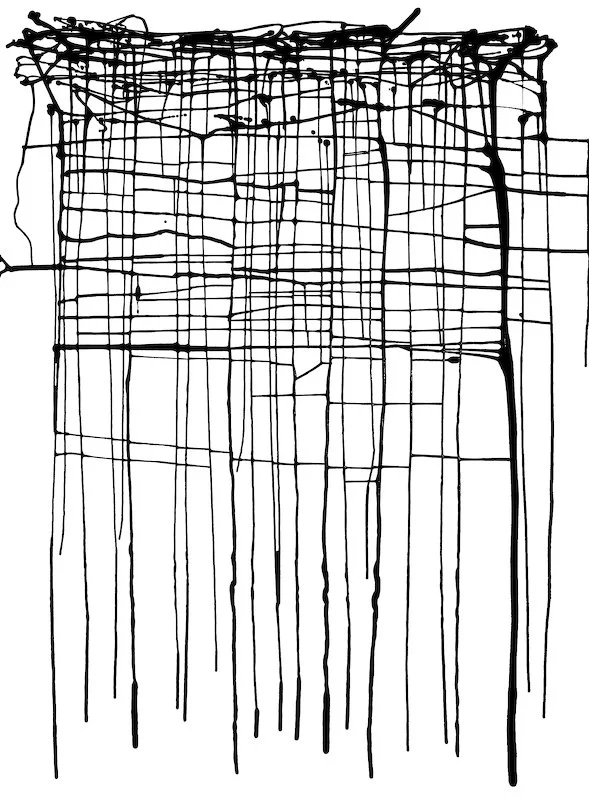
Endless Roads, Untitled XV, 2006, Ink on Paper, 60" X 44"
