
Letter NO. 08 | Lisa Blas
The Art of Looking Slowly
In an era when contemporary painting often leans toward spectacle or conceptual grand gestures, the work of Lisa Blas offers something rarer: a sustained meditation on attention. Her paintings do not rush toward declaration. Instead, they unfold gradually, inviting viewers to linger, to look again, and to rediscover the quiet complexity of perception itself.
Based in New York, Blas has developed a body of work rooted in close observation of the natural world. Trees, branches, and shifting atmospheres appear throughout her paintings, not as fixed subjects, but as catalysts for a deeper exploration of movement, light, and memory. The natural environment becomes less a landscape to depict than a field of relationships: between form and dissolution, presence and disappearance, clarity and ambiguity.
At first glance, her canvases hover somewhere between abstraction and representation. Gestural marks suggest branches or clusters of leaves, while layered passages of paint create a sense of depth and shifting space. But the longer one spends with these works, the clearer it becomes that Blas is not merely painting nature; she is painting the experience of encountering it. The images seem to emerge through the act of looking itself.
This attentiveness extends to the structure of the paintings. Blas builds her surfaces through layers that feel both deliberate and intuitive. Marks accumulate, dissolve, and reappear, producing a visual rhythm that mirrors the organic patterns of growth and change found in the natural world. The result is a dynamic tension: the paintings appear in motion even while they remain still.
What is most compelling about Blas’s work is its embrace of uncertainty. Rather than resolving forms into definitive images, she allows them to remain open, suspended in states of transformation. Branches flicker into visibility before dissolving into fields of color; atmospheric passages suggest light filtering through foliage, only to shift again into abstraction. In this way, the paintings resist the finality that often accompanies representation. They remain alive to possibility.
This approach places Blas within a lineage of painters who have treated nature not simply as subject matter but as a site of inquiry, artists for whom landscape becomes a way to think through perception itself. Yet her work avoids the grandiosity often associated with such traditions. There is a humility in her process, a willingness to let the painting evolve slowly rather than forcing it toward resolution.
In a cultural climate defined by speed and distraction, the quiet insistence of Blas’s paintings feels almost radical. They ask viewers to slow down, to trust the act of looking, and to recognize that meaning in painting often resides not in immediate clarity but in sustained attention.
Standing before one of her canvases, one becomes aware of something subtle yet profound: the painting is not merely an image of nature. It is a record of time spent looking, of an artist patiently tracing the fragile, ever-changing boundary between the world and our perception of it.
And in that space, Lisa Blas reminds us that painting, at its most compelling, is not only about what we see. It is about how we learn to see again.
Learn more about her work: www.lisablas.com
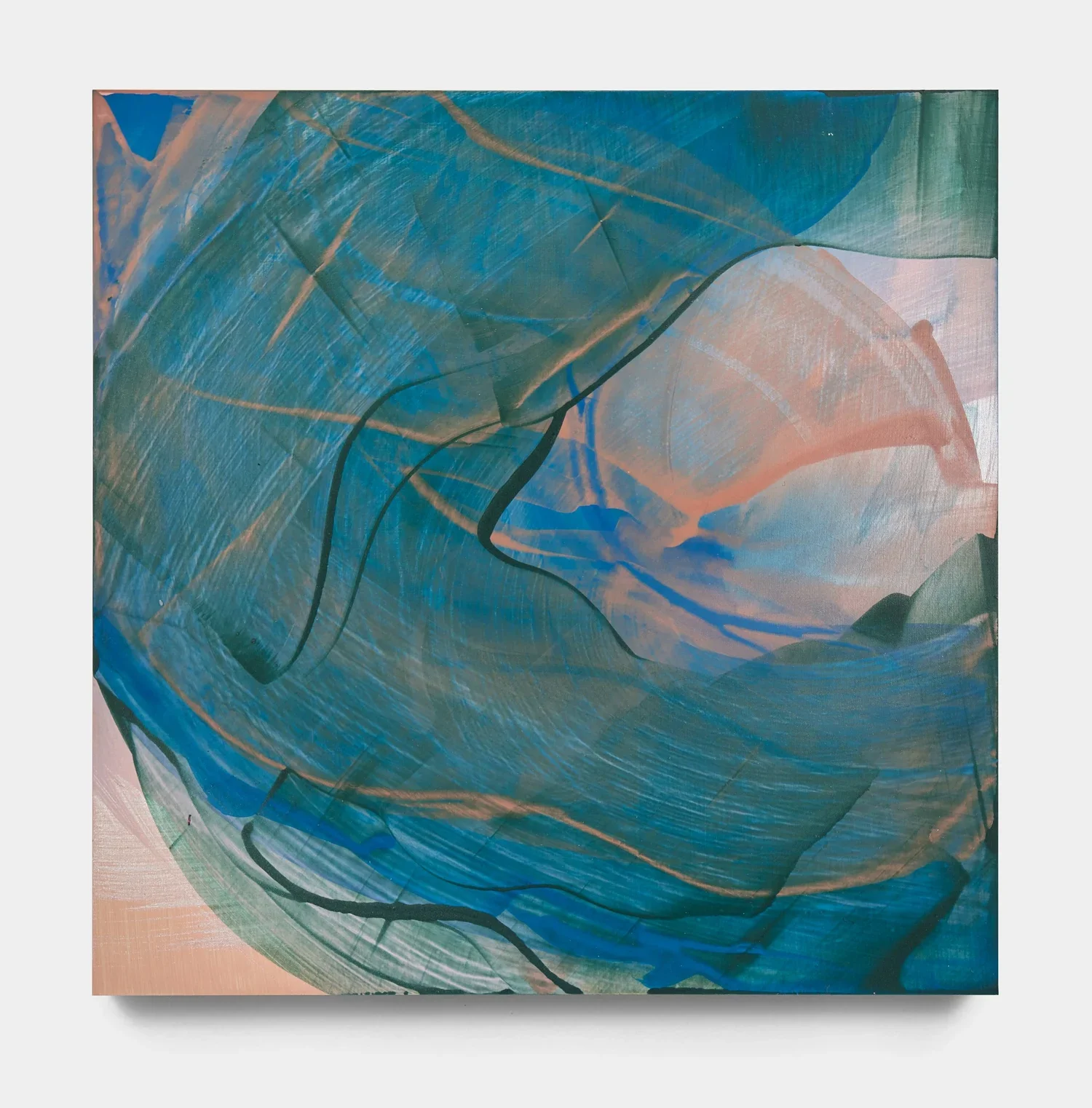
Routes to Oceania: roots / routes, 2021
