
Letter NO. 12 | Red Sagalow
The Shape of Testimony
There is a tendency, particularly when discussing socially engaged art, to begin with its subject matter. We ask what an artist is responding to, which injustices they seek to expose, or which communities they represent. In the case of Red Sagalow, these questions are unavoidable. Her work engages with gender, violence, memory, and the social structures that have long shaped women's lives. Yet to understand her practice primarily through these themes is to overlook what makes it distinctive. The enduring achievement of Sagalow's work lies not simply in what it represents, but in how it transforms lived experience into a shared public encounter.
Working across sculpture, installation, printmaking, drawing, photography, and public art, Sagalow has developed a practice guided less by allegiance to a single medium than by the questions each work demands. Rather than beginning with material, she begins with experience, asking what form a particular story requires in order to be seen, heard, and remembered. In her work, medium is never an aesthetic preference; it is an ethical decision.
This approach reflects a conviction that personal experience is never entirely private. The stories that shape individual lives are inseparable from the larger cultural, political, and historical forces that produce them. Sagalow does not present autobiography as confession. Instead, she reveals how intimate experiences become sites through which broader structures of power, exclusion, and resilience can be understood. Her work consistently moves from the singular toward the collective, inviting viewers to recognize that private memory often carries public consequence.
One of the defining characteristics of Sagalow's practice is her use of accumulation. Individual figures, objects, and gestures rarely stand alone. They gather into larger constellations, allowing personal experience to acquire social dimension. In 100 Women and More, repetition is neither decorative nor formalist. Each figure retains its individuality, yet together they construct a portrait of collective experience. The work refuses to collapse many lives into a single symbol. Instead, it suggests that structural injustice becomes visible precisely through the accumulation of singular stories. What begins as portraiture gradually becomes an image of society itself.
This understanding of repetition also distinguishes Sagalow from many artists working within traditions of Minimalism or Conceptual Art. For her, repetition is never an exercise in formal order. It is an ethical gesture. Each repeated figure insists that another life deserves to be seen, another voice deserves to be acknowledged. Quantity does not erase individuality; it amplifies it. The viewer comes to understand that no single story can stand for all others, yet together these stories reveal patterns that no individual experience could expose on its own.
The body occupies an equally significant place throughout her work, though not as an idealized figure or psychological portrait. Her figures function instead as repositories of experience. They carry traces of memory, vulnerability, endurance, and survival. They remind us that history is not something that exists outside ourselves but something that becomes embedded within the body, leaving marks that remain long after public attention has shifted elsewhere.
This understanding places Sagalow within an important lineage of artists concerned with embodiment and feminist thought, yet her work ultimately exceeds those categories. She is less interested in representing identity than in examining how experience itself is carried, remembered, and transmitted. The female body becomes neither symbol nor metaphor alone, but a living archive through which overlooked histories continue to speak.
Equally significant is Sagalow's refusal to privilege material over meaning. Sculpture, printmaking, photography, drawing, and installation are not separate disciplines within her practice but different vocabularies available to the same investigation. Material never precedes thought; it follows it. This flexibility reflects a rare resistance to artistic branding. Rather than becoming identified with a signature medium, Sagalow allows each body of work to determine its own formal language. Such an approach demands an unusual degree of openness, one that places the needs of the work above the consistency of style.
Her early engagement with theater and filmmaking continues to shape the spatial intelligence of her installations. The influence is subtle but unmistakable. Objects are arranged not simply for visual balance but for narrative rhythm. Viewers move through the work as though entering an unfolding sequence rather than encountering isolated sculptures. Every relationship between object, space, and movement contributes to a larger emotional structure. The exhibition becomes less a collection of artworks than a carefully composed environment in which meaning emerges through experience.
Underlying all of these formal decisions is a profound belief in storytelling—not as illustration or confession, but as an act of witness. In a culture increasingly saturated with images that compete for attention only to disappear moments later, Sagalow asks something radically different of her audience. She asks them to slow down. Her work insists that understanding requires duration, that empathy demands sustained attention, and that remembrance is not passive recollection but an active ethical practice.
This insistence feels particularly urgent today. We live in a moment when visibility is often mistaken for recognition and information for understanding. Sagalow reminds us that these are not the same. To witness another person's experience requires more than observation. It asks for patience, attentiveness, and a willingness to remain present before realities that resist easy resolution.
Perhaps this is why her work never offers the comfort of closure. It neither promises redemption nor surrenders to despair. Instead, it inhabits the difficult space between them, where vulnerability becomes a source of knowledge and uncertainty remains essential to genuine human understanding.
At a time when public life increasingly rewards speed, certainty, and immediate reaction, Red Sagalow offers something slower and ultimately more demanding. Her work asks us to remain with experiences that resist resolution. It reminds us that memory is not simply preserved in archives or institutions but carried by bodies, relationships, and stories that continue to shape the present.
Art cannot reverse injustice, nor can it restore what history has erased. But it can resist disappearance. It can insist that overlooked lives remain visible, that difficult conversations remain unfinished, and that private testimony has the power to alter public consciousness.
There are artists who document the world as it is. Others imagine the world as it could become. Red Sagalow occupies the difficult space between these positions. She transforms lived experience into a place where recognition becomes possible, where empathy becomes a form of knowledge, and where the simple act of paying attention becomes an ethical responsibility.
Her work asks us not merely to remember the past, but to reconsider how we carry it into the future.
Learn more about her work: https://redsagalow.com/
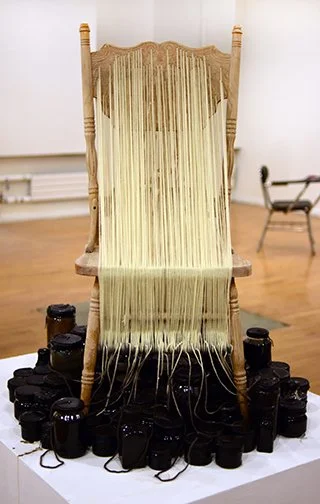
Processing, 2019, Yarn, wood, jars, wax, dye, and chair 42 x 19 x 20 inches
