
Sarah Leahy
A Forest, Drawn in Ink, That Is Already Dying
At EFA Gallery, Sarah Leahy spends thirty-three feet of wall on a single grove of beech trees, and lets a quiet fact do the emotional work no brushstroke does.
There is a particular kind of attention that only comes from having looked at something for years, and you can feel it before you understand why in Sarah Leahy's "Plain Sense," on view in Manhattan through December 8. The piece is not painted so much as it is grown across two adjoining walls, thirty-three feet of black India ink applied directly to the gallery's sheetrock: a beech grove rendered as if lit from somewhere just behind the leaves, branches and bramble accumulating into a thicket so dense it reads, from a few steps back, almost as static, the visual equivalent of white noise, until a single trunk resolves itself in near-black ink at the work's far right edge and the whole image snaps into focus.
Leahy has spent much of her career moving between two surfaces, ink on plexiglass and ink on the wall itself, and part of what makes "Plain Sense" feel like a culmination rather than a departure is that she has, this time, given up the plexiglass entirely. There is no transparent plane between the image and its support, no pane to catch the room's light and throw it back at the viewer. The ink sits directly in the wall's own whiteness, and the effect is less of looking at a picture than of finding an image that has always been latent in the architecture, waiting to be developed.
The show's title comes from Wallace Stevens's late poem "The Plain Sense of Things", the wall text supplies the line "Yet the absence of imagination had itself to be imagined", and it is a smarter borrowing than most exhibition titles manage. Stevens's poem is about the difficulty of seeing a thing without immediately dressing it in metaphor, and Leahy's mural performs the same problem in paint. This is, on its surface, a very plain picture: a stand of trees, drawn from a collage of photographs she took several years ago, rendered without a horizon line, a figure, or any of the usual devices that tell a viewer how to feel. The mark-making is direct to the point of severity. There is no visible underdrawing, no correction, no sentimentality in the handling, just the accumulated evidence of a hand that has been in front of this wall, alone, for a long time.
What keeps the piece from being merely a feat of scale and discipline is a fact the gallery includes almost in passing: the beeches in Leahy's source photographs, she has since learned, are dying of blight. Beech leaf disease has been moving through forests in the Northeast for several years now, and it does not announce itself with obvious devastation, the leaves curl and darken in a way that, from a photograph taken before anyone knew to look for it, is nearly invisible. Leahy did not repaint the mural to register this. She did not add a dying branch, a fallen trunk, any visual concession to elegy. The image is exactly the image it would have been without the diagnosis. What has changed is only what the viewer knows, and that turns out to be enough: once you have read the wall text, you cannot look at these leaves as simply leaves again. It is a rare thing for a work of art to let information, rather than mark-making, do that much of the emotional labor, and it is a genuinely elegant solution to a problem a lot of nature-and-climate-adjacent art solves much more clumsily, by editorializing.
It is also, I think, a slightly risky one. Leahy is gambling that most visitors will actually read the didactic panel before they look, or will return to the image after they have, that the blight will land as revelation rather than footnote. Gallery-goers are not always so patient, and a viewer who walks the length of the mural, admires the ink-wash virtuosity, and leaves without absorbing that single sentence about disease will have had a different, thinner experience of the same eleven weeks of work. The piece's quietness is its major strength and its real vulnerability at once: it refuses to make its stakes visible on the wall, which is intellectually honest and formally consistent with everything else Leahy is doing here, but it also means the work's full meaning lives, uncomfortably, off the wall, in the wall text, in the title's borrowed poem, in whatever the viewer already knows about the state of American forests.
Formally, "Plain Sense" belongs to a lineage of site-specific wall drawing that runs back at least to Sol LeWitt, though Leahy's version inverts most of what made LeWitt's work radical. His wall drawings were instructions, systems that could, in theory, be executed by anyone, anywhere, and that treated the individual hand as beside the point. Leahy's mural is the opposite kind of gesture: it is legible, at close range, as nothing but hand, a record, in the variable pressure of ink on wall, of one particular person's eleven weeks in one particular room. It shares more, formally, with the tonal restraint of ink-wash and sumi-e traditions than with anything in American wall-drawing's conceptualist branch, and it is worth noting that this is not new territory for Leahy: her earlier "Conditions of Light" murals, seasonal studies in the same black ink, on the same scale, were already organized around the idea that a painted image, if you let it, can accumulate "presence," can make a viewer pause and register its actual physicality rather than consume it as information. "Plain Sense" is what happens when that same commitment to presence collides, almost by accident, with a piece of bad ecological news the artist did not go looking for. The trees don't know they're an elegy. That is exactly why the drawing of them works as one.
Sarah Leahy: Plain Sense. Through Dec. 8, Manhattan; curated by Deric Carner.
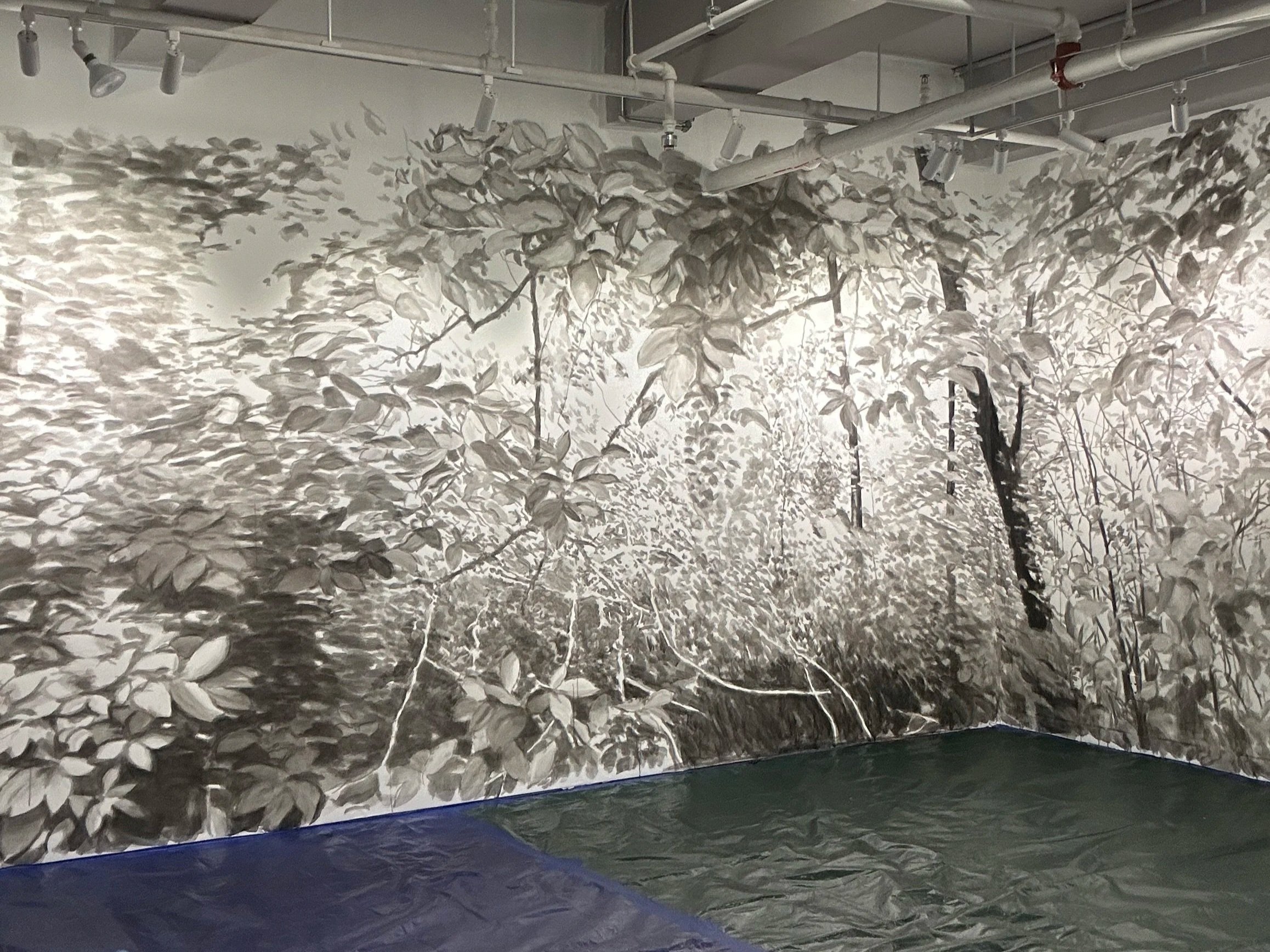
Plain Sense, 2026, Work in progress
