
Letter NO. 06 | Gemma Sharpe
Listening to the Silences of Art History
There are scholars who describe art history, and there are those who quietly rearrange its foundations. Gemma Sharpe belongs to the latter. Her work moves through the archive not as a neutral observer, but as a patient listener, attentive to the voices that modern art history has too often left unheard.
For decades, the story of modernism has been told along a familiar axis: Paris, New York, Berlin. These cities formed the gravitational centers of a narrative that seemed both inevitable and complete. Yet outside that map, entire constellations of artists were working, experimenting, and negotiating their own visions of modernity. Sharpe’s work begins precisely in those overlooked spaces.
Her research turns toward South Asia, particularly Pakistan and Bangladesh, where artists were shaping modernist languages under conditions very different from those typically celebrated in Western histories. These were years marked by the turbulence of postcolonial nation-building, by cultural diplomacy, and by the quiet but persistent presence of the Cold War. Art did not exist apart from these forces, it moved through them.
What fascinates Sharpe is not simply the work itself, but the subtle strategies artists used to navigate these complex environments. Rather than adopting the dominant forms of Western modernism wholesale, many artists worked through mediums often dismissed as secondary: drawing, printmaking, and the intimate space of the artist’s book. In these forms, Sharpe sees not marginality but possibility, a way of working at the edges of institutional expectation, where new visual languages could emerge.
In her writing, these mediums become more than technical choices. They appear as gestures of negotiation, between tradition and experimentation, between the pressures of nationalism and the desire for artistic autonomy. Through careful archival research and close attention to artistic practice, Sharpe reveals a modernism that is less a universal style than a field of shifting negotiations.
There is something quietly radical in this approach. Instead of asking how artists outside Europe and the United States participated in modernism, Sharpe asks a different question: what if the history of modernism itself has always been incomplete?
Her work does not simply add new artists to an existing narrative. It alters the structure of that narrative entirely. The center begins to shift. The margins speak.
Part of the strength of Sharpe’s perspective comes from experience lived within the worlds she studies. Years spent in Karachi, teaching, collaborating with artists, and engaging with local institutions, shaped her understanding of how artistic communities form and evolve. Her scholarship carries the texture of those encounters: attentive, grounded, and deeply aware that art history is not only written in museums and archives, but also in studios, conversations, and fragile networks of exchange.
Reading Sharpe’s work, one senses that the archive is not a fixed repository but a landscape still being uncovered. Each recovered exhibition, each reexamined artwork, expands the map slightly further. The result is a vision of modern art that feels less centralized, less certain, and infinitely more alive.
In the end, Gemma Sharpe’s work reminds us of something essential: art history is not only about the works we already know, but about the histories we have not yet learned how to see.
Learn more about Gemma’s work here: gemmasharpe.info
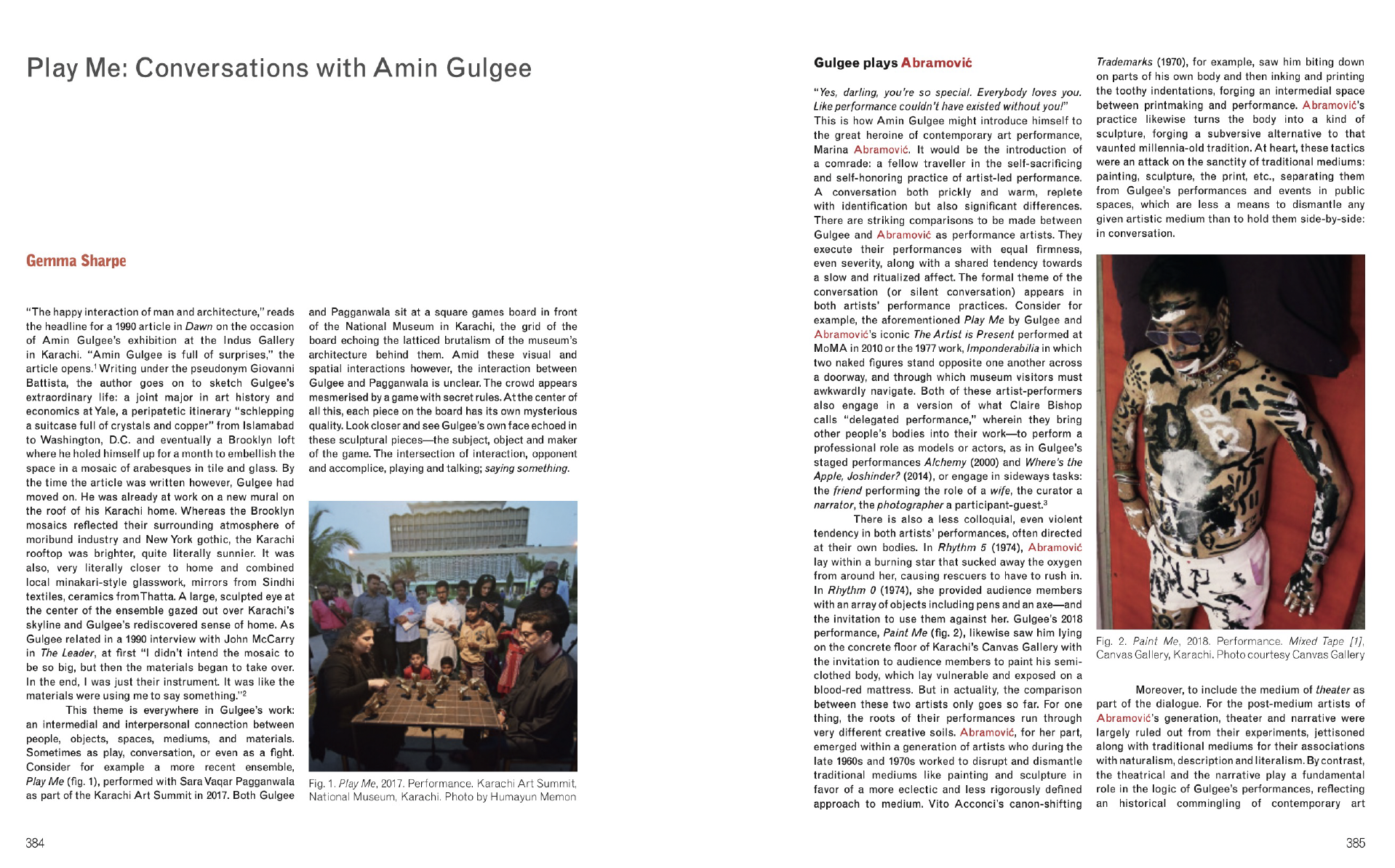
“Play Me: Conversations with Amin Gulgee” now out in Amin Gulgee: No Man’s Land, (2025: Skira)
My essay on Amin Gulgee’s practice in its art historical context is now out in the monograph No Man’s Land published by Skira in 2025 and edited by John McCarry.
