
Letter NO. 13 | Cecilia Mandrile
The Memory of Things
There is a persistent misconception that memory belongs solely to the mind. We speak of remembering as though it were an act of consciousness alone, something preserved in language or thought. Yet artists have long understood that memory resides elsewhere as well in the texture of worn fabric, the surface of a faded photograph, the weight of a porcelain cup carried across continents, or the imprint left by a hand that is no longer present. Objects remember differently than people do. They do not narrate; they endure.
It is within this quiet territory that Cecilia Mandrile has built her artistic practice.
Over the course of more than three decades, Mandrile has developed a body of work that resists easy classification. Although she is internationally recognized for her contributions to contemporary printmaking, the language she has cultivated extends well beyond the printed image. Photography, drawing, sculpture, artist books, installation, found objects, and printmaking exist not as separate disciplines but as interconnected ways of asking a single question: How do we carry our lives through time?
The question is deceptively simple. Its implications are not.
Born in Argentina and shaped by years of living and working across continents, Mandrile has never treated displacement as a singular biographical event. Instead, she approaches it as an enduring psychological condition—a continual negotiation between memory and forgetting, attachment and transformation. Geography matters in her work, but it is never merely geography. Every movement across borders alters the meaning of the things that accompany us. An ordinary household object becomes an heirloom. A family photograph becomes evidence. A fragment of lace, a paper doll, a worn suitcase, or a printed image begins to carry more than its physical form. These objects become vessels through which history continues to speak.
This sensitivity to material memory distinguishes Mandrile from many artists working within the discourse of migration and identity. Contemporary art often approaches displacement through spectacle or political declaration. Mandrile chooses another path. Her work unfolds through accumulation rather than assertion. Meaning emerges gradually through repetition, careful observation, and the patient choreography of objects placed into conversation with one another.
Printmaking lies at the center of this philosophy.
Historically, the printed image has been associated with reproduction, circulation, and multiplicity. Mandrile embraces these qualities while quietly transforming their meaning. In her hands, repetition is never mechanical. Every transfer alters the image; every impression introduces subtle differences. Each act of printing acknowledges that memory itself changes every time it is recalled. There is no original untouched by time only successive translations.
Translation is perhaps the defining condition of her practice.
Images migrate from photograph to paper, from engraving to sculpture, from object to installation. They are folded, layered, dismantled, reconstructed, and reimagined. Rather than seeking permanence, Mandrile allows images to remain unsettled, recognizing that identity itself is never fixed but continuously rewritten through experience.
This openness gives her work a remarkable emotional intelligence. Nothing feels illustrative or didactic. Even when addressing migration, domestic life, loss, or inheritance, she resists the certainty of conclusion. Her installations invite viewers to inhabit ambiguity—to recognize that belonging is rarely complete and that memory often survives precisely because it remains unfinished.
There is also a profound ethic of care embedded within her practice.
Care is evident not only in the subjects she chooses but in the labor of making itself. The slow processes of printing, cutting, arranging, collecting, preserving, and assembling become acts of sustained attention. In a culture increasingly dominated by speed, immediacy, and digital impermanence, Mandrile insists upon another rhythm. Her work reminds us that understanding requires time, that intimacy develops through repeated encounters, and that some forms of knowledge emerge only through patient observation.
Perhaps this is why her work feels deeply contemporary without ever chasing contemporary trends. While artistic movements shift and critical vocabularies evolve, Mandrile has remained remarkably consistent in her commitment to the material life of memory. Her practice continues to ask questions that resist historical expiration: What do we inherit? What do we choose to carry? What disappears despite our efforts to preserve it? And how might art become not simply a record of experience, but one of the ways experience itself is transformed?
What makes Mandrile's work so quietly affecting is its refusal to separate memory from materiality. It asks us to look again not only at the objects that surround us, but at the invisible histories they carry. In her work, objects are never passive remnants of the past. They remain active participants in the ongoing construction of identity, reminding us that what endures is rarely monumental. More often, it is quiet, intimate, and easily overlooked.
To encounter Cecilia Mandrile's work is to recognize that memory is not opposed to change; it is shaped by it. Every act of remembering alters what is remembered, just as every printed impression bears the trace of those that came before it. Her art embraces this instability with remarkable generosity, allowing images and objects to continue their lives rather than preserving them in a fixed state.
In the end, Mandrile offers more than a meditation on migration, memory, or materiality. She proposes a different ethics of looking one grounded in patience, attentiveness, and the belief that even the smallest things can hold the deepest histories. It is through these quiet acts of observation that her work reminds us of one of art's most enduring capacities: not merely to represent experience, but to carry it forward.
Learn more about her work: http://www.ceciliamandrile.com/
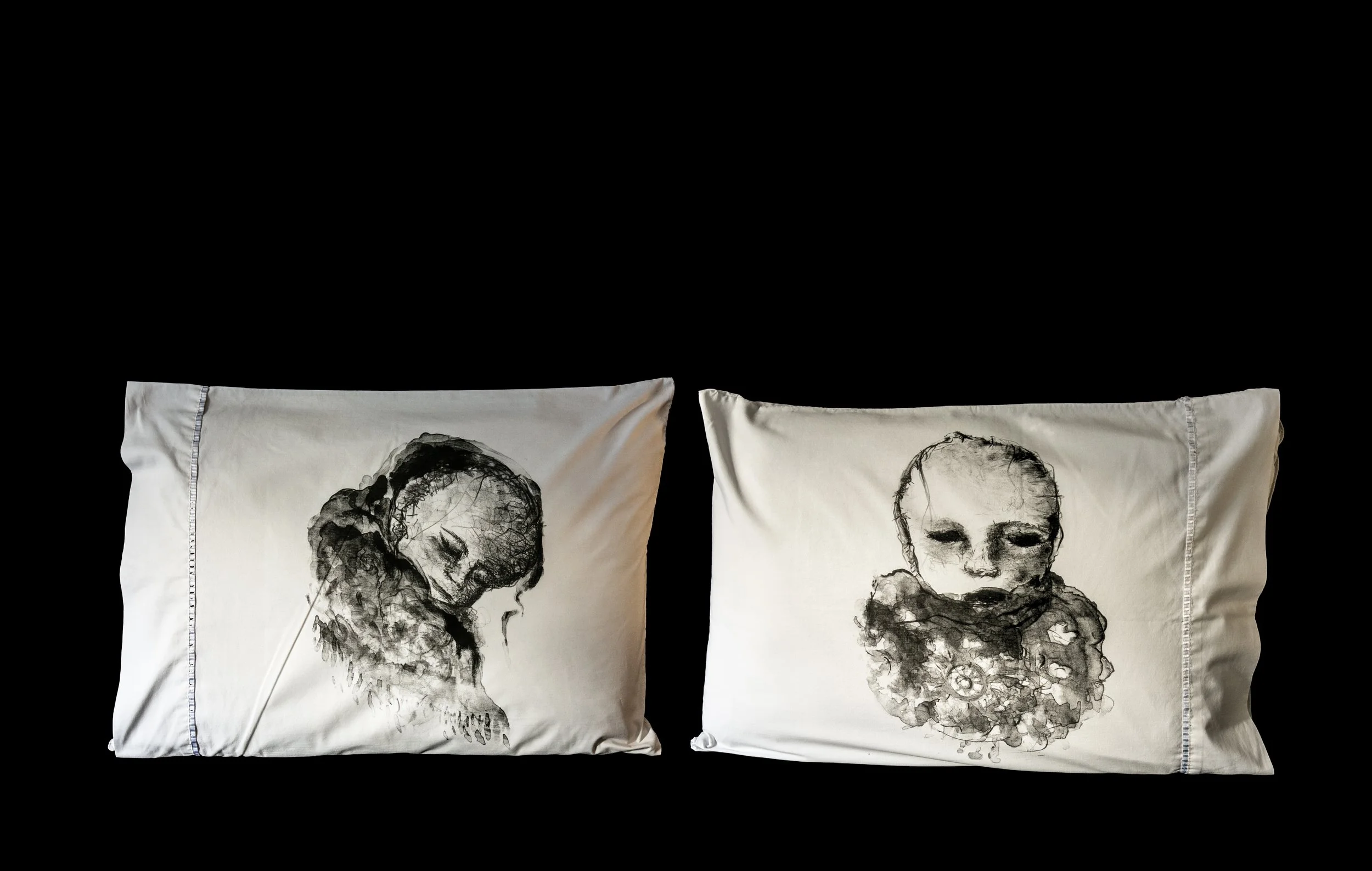
The Last Dream, 2023, Lithography on pillows inherited from lost loved ones.
